Black Hole — it is genuinely hard to find anyone who is not interested in them. But the subject is not so small that a single article can tell you all about it. And it goes without saying how large the matter becomes once you go into the mathematical analysis. So let's begin the basic discussion of black holes.
Let's start with a basic idea of what a black hole is. A black hole is a place in the universe where the force of gravity is so intense that nothing can get out of it — never mind anything else, not even light, the fastest-moving thing in the universe! Not only that: inside this black hole even time surrenders to that intense gravity and stops! So if someone once falls into a black hole, two things will happen to them: 1. They will never be able to get out. 2. Time will stand still for them. That is, they will not age. They will stay the same age for ever. So do refrain from wandering about near a black hole 😜
Anyway, this cute name for the black hole was given by the physicist John Wheeler, in 1969. But at the words ‘black hole' what comes to everyone's mind is the physicist Albert Einstein and Stephen Hawking.
The scientist Einstein showed by calculation, in his General Theory of Relativity, that black holes would exist in this universe. Alongside him the theoretical physicist Stephen Hawking also did a great deal of work on black holes during his life. Sadly, though, he did not live to see a picture of one: he died about a year before it was published.
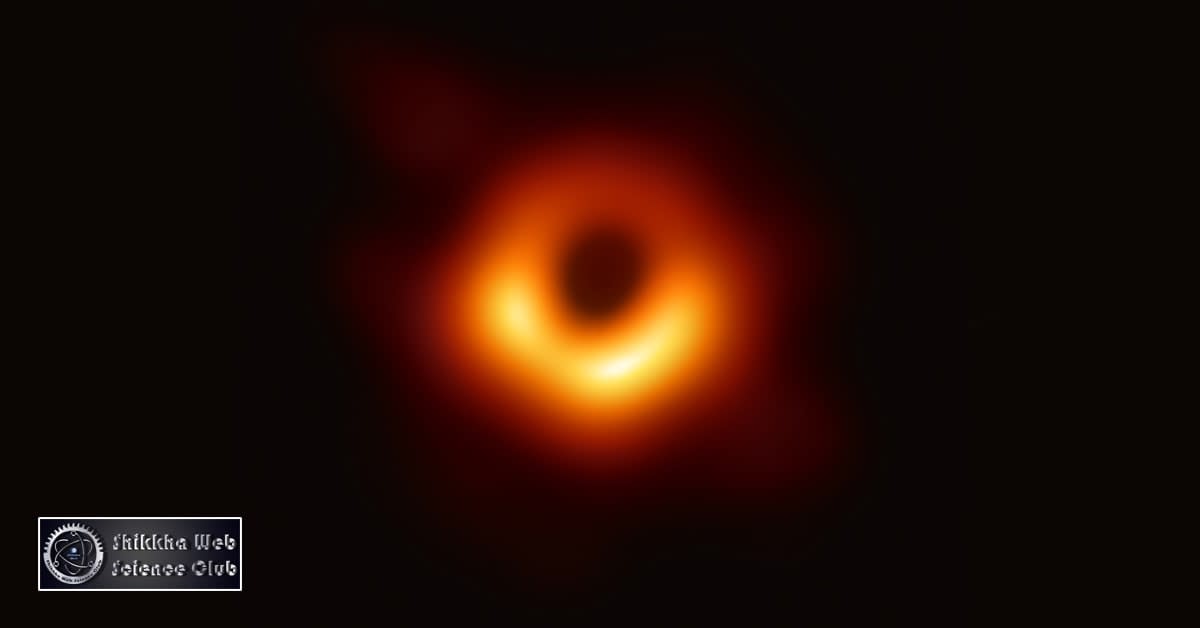
On 10 April 2019 the Event Horizon Telescope (EHT) published the first ever image of a black hole.
The idea of black holes is quite old, though. It has been thought about for nearly 200 years. To understand a black hole, the first thing you have to know is this: is light a wave or a particle?
On this question scientists were at one time divided into two camps. One camp claimed light was a kind of wave. The other claimed light was a kind of particle. Both camps had plenty of arguments. Later it turned out that both camps were in fact right. Light is a particle and a wave at the same time.
Now if light is a particle then it is natural for gravity to act on it, because gravity attracts every particle. But at first nobody had a clear idea about the speed of light. Everyone thought the speed of light was infinite, so the force of gravity could not exert any influence on light. Later, though, it turned out that the speed of light is finite — and it is about 3×10⁸ ms-1।
Now the scientists sat up. Since the speed of light is not infinite, light could be thoroughly brought down by the force of gravity 😉 So it was on this idea that the black hole was built: a thing whose gravity would be so intense that light, for all its enormous speed, would lose and be trapped in that dark pit!
That is all for today. Tomorrow, in the second and final part, comes our mission to defeat the great Mr Light.